
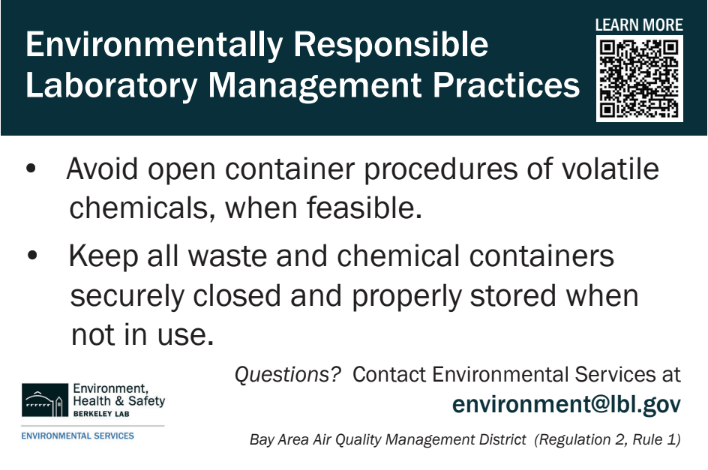
Fume Hood Sticker Posting – Pilot
Lead ESG Staff: Bernadette Santos (bsantos@lbl.gov), Air Quality Specialist. All Berkeley Lab fume hoods will be posted with a notice to abide by Responsible Laboratory Best Management Practices, as required by the Bay Area Air Quality Management District. This is not a new requirement and it currently exists in existing policy documents including, but not limited to: Waste Management Practices and Chemical Hygiene Plan.
Resources/Frequently Asked Questions:
1. How will this affect my current research that is being conducted in a fume hood?
As long as you have obtained approval via the Work Planning & Control process for your operation, your operations/research can continue as is, as long as you continue to keep all waste and chemical containers securely closed and properly stored when not in use.
2. What do I do with residual chemicals?
Please contact your assigned Waste Services Generator Assistant or submit a ticket via the Waste Management Technical Support Request form to properly determine how to dispose of residual chemicals for your operation. Evaporating volatile chemicals as a means of waste disposal is not allowed. Once we identify the most common scenarios, we’ll be sure to update this page to assist other researchers.
3. Is there a list of volatile chemicals that the Air District is concerned with?
Yes! The Air District is most concerned with Toxic Air Contaminants (see the full list within Table 2-5-1 of Regulation 2, Rule 5, amended 2021). Triggering any of these quantities in your research may require air permits. If you believe your research exceeds any of these thresholds, please contact environment@lbl.gov to coordinate an analysis of your research to determine applicable environmental regulations.
4. I have fume hood functionality questions or concerns. Whom do I contact? Please contact fumehood@lbl.gov for assistance.
Refrigerant Servicing/Disposal
Lead ESG Staff: Bernadette Santos (bsantos@lbl.gov), Air Quality Specialist
If your research operations handle refrigerant/freon from an appliance that contains 5 lbs. or more, the Environmental Protection Agency requires recordkeeping regarding the servicing/disposal of the refrigerant. ESG will work with you to better understand what records must be kept and maintained for these situations.
Sulfur Hexafluoride (SF6)
Lead ESG Staff: Bernadette Santos (bsantos@lbl.gov), Air Quality SpecialistSulfur Hexafluoride is regulated under the California Air Resources Board’s “Regulation for Reducing Sulfur Hexafluoride Emissions” (17 CCR §§ 95340 through 95346). Prior to procurement, EHS will need to assess whether the use of sulfur hexafluoride for your research falls under an exempted category of use, requires registration and routine reporting, or requires an exemption for research use.
Spill Prevention, Control and Countermeasure Plan
Lead ESG Staff: Bernadette Santos (bsantos@lbl.gov), Environmental Specialist
Researchers can access the Spill Prevention, Control and Countermeasure Plan (SPCC) to learn more about the oil discharge prevention program.
Oil-containing equipment and bulk storage containers with a capacity of 55-gallons or more are required to be inventoried in Berkeley Lab’s SPCC Plan.

