General PPE Requirements
When working with cryogenic liquids, the following PPE is always required:
- Long pants/trousers without rolled cuffs that may catch cryogenic liquid spills
- Long sleeves or a laboratory coat
- Closed toe shoes without mesh or porous tops
- Safety glasses with side shields suitable for chemical work
The following additional PPE is required when dispensing cryogenic liquid from a pressurized source or when handling cold transfer lines. It is also recommended when there is risk of cryogenic liquid splash to the hands:
- Cryogen gloves
The following additional PPE is required when pouring liquid nitrogen above chest height or when performing work with a high risk of cryogenic liquid splash:
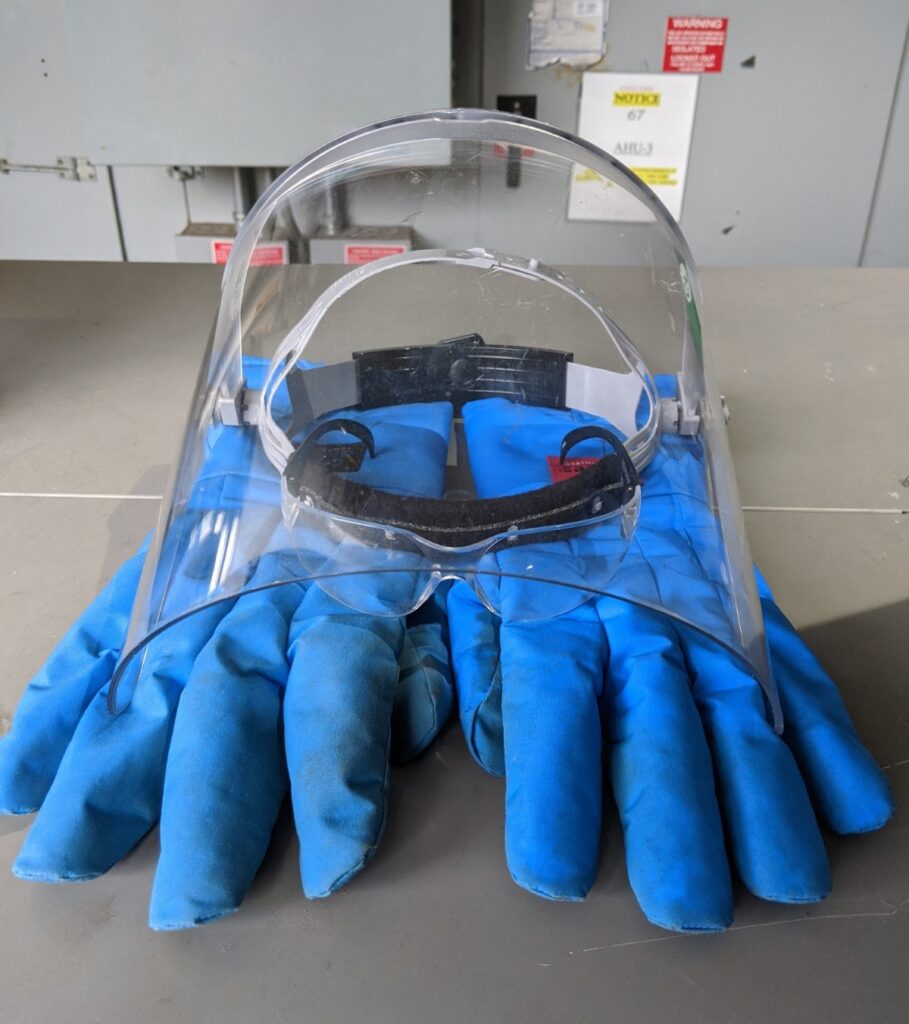
- A face shield
The following additional PPE is recommended on an as-needed basis depending on the task:
- A chemical resistant apron
- Chemical resistant sleeves

Face Shields
The primary function of a face shield is to protect the head and face in case of a splash. A good face shield should have adjustments to fit many head sizes and should provide good coverage of the entire front of the head, including around the sides. Some mechanism to lock the shield in place so that it doesn’t slip down and touch the chest or nose is recommended to improve comfort. The shield should have a sloped top surface to direct splashes away from the top of the head and to prevent splashes from getting behind the shield from above. Even better is a face shield with impact resistance, per ANSI Z87.1, which is indicated by a marking of “Z87+” on the face shield surface, but this is not a requirement. Some models have replaceable clear shields so that when the shield becomes scratched or dirty, it can be replaced without purchasing new headgear.
NOTE: You must still wear safety glasses underneath the face shield.
Cryogen Gloves
Before using cryogen gloves, always inspect them for ripped seams, tears or holes where cryogenic liquid could get inside the glove.
Cryogen gloves are intended for brief handling of very cold items and to protect against an accidental splash. Cryogen gloves will NOT protect against submersion in a cryogenic liquid, or prolonged contact with cryogenically cooled objects. Additionally, cryogen gloves lose all protective ability when the outer layer absorbs moisture or the inner insulating material becomes wet. Ideally, cryogen gloves will be loose fitting and easy to remove. This feature makes it easy to get the glove off in a hurry if cryogenic liquid ever becomes trapped inside the glove against the skin.
Note that chemical protective gloves and heat protective gloves are not effective for protection from cryogenic liquid splash or contact with extremely cold items, even briefly.
If possible, keep a separate pair of cryogen gloves in each location where they may be needed so that they’re always readily accessible.

This research groups keeps a pair of cryo gloves and an ice scraper conveniently located for use with their -80 freezers.

Cryo gloves with elastic wrists are not recommended. Liquid nitrogen may absorb into the elastic cuff and cause burns, and they take more time to remove, increasing the potential for burns.
Two examples of damaged cryo gloves

This is the most commonly found damage to cryo gloves – ripped seams.

Although less common, the fabric of the glove can become damaged.
Absorbent Materials Can Be Dangerous
Recently, we learned the hard way that absorbent materials can and do absorb liquid nitrogen and can cause serious burns. Even a small, incidental splash of liquid nitrogen can be absorbed by some materials, trapping the ultra-cold liquid against the skin. Therefore, it is important to ensure that you have no absorbent materials near your hands or wrists while performing work with cryogenic liquids. Similarly, avoid thermally conductive materials such as metal watches and jewelry that may become cooled by a liquid nitrogen splash and cause burns.

Closed-Toe Shoes
It is increasingly common to wear athletic shoes into the laboratory, which are often designed to keep the feet cool, with webbed mesh tops for air flow. Unfortunately, if the shoes allow airflow, they may also allow cryogenic liquid into the shoe through the top in the case of a spill or splash, and are often time-consuming to remove. Appropriate shoes for use with cryogenic liquids should cover the entire top of the foot and should be able to at least temporarily repel liquids. Shoes with webbed or mesh tops are not permitted when handling cryogenic liquids. In the photograph, the shoes on the left are excellent for cryogenic liquids work, while the shoes on the right are unacceptable.
Experimental Data: Shoes and Liquid Nitrogen
The data presented to the right shows the temperature inside of three different types of shoes during a liquid nitrogen splash event. Data was collected on a data-logging thermometer with bare junction thermocouples. Tests include a tightly laced leather oxford with liquid nitrogen splash across the entire upper surface of the shoe, a loafer with a loose fit to the top of the foot with liquid nitrogen splash to the upper, open portion of the shoe, and a tightly laced athletic shoe with breathable mesh top.

Long Pants/Trousers
Long pants/trousers or an equivalent* are required during all work with cryogenic liquids; shorts and cropped pants are unacceptable. Furthermore, pants/trousers with cuffs can trap cryogenic liquid in the fold of the cuff and against the skin, increasing the chance of cryogenic burns. Cuffed pants/trousers are not permitted to be worn when handling cryogenic liquids. It is also recommended to wear loose-fitting pants/trousers so that any spilled or splashed cryogenic liquids will roll off the fabric without transferring significant heat into the skin. Tight jeans or leggings provide less protection against cryogenic liquid splashes.
*Is it ever acceptable to wear a skirt when handling cryogenic liquids?
The short answer is yes, but only carefully.
The entire point of long, cuffless pants/trousers is to ensure that all of the skin is covered and that there are no folds where cryogenic liquid could become trapped against the skin, causing burns. Protection from cryogenic liquids requires that the clothing promotes any splashes or droplets to roll off and away from your person. Some skirt or dress and shoe combinations will accomplish this as well as any pants or trousers (and potentially better). And skirts may always be worn over the top of long pants. However, if the ankles or the top openings of the shoes are exposed, this leaves you vulnerable to getting burned if cryogenic liquid splashes onto your lower body. Given that splashes will generally originate at low height to start with and flow downward, the lower body and especially the feet are at increased risk of exposure to cryogenic liquid splashes.
If you must wear a dress or skirt for any laboratory work, the skirt either needs to be worn over the top of long pants, or it needs to be full length and should ideally completely cover the skin all the way down past the tops of the shoes. Boots underneath the skirt are recommended to ensure that nothing gets splashed into the shoes.

