WARNING: Liquid hydrogen is extremely dangerous. Contact your Division Safety Coordinator for help planning your work before ordering liquid hydrogen.
In addition to being one of the coldest cryogenic liquids with a boiling point of only 20 Kelvin, hydrogen is extremely flammable with a flammable range in air of approximately 4-75% by volume, and it readily forms explosive mixtures in air. Even if an asphyxiation hazard does not exist from boil-off of hydrogen gas, the atmosphere around the source may still be flammable and/or explosive. The initiation energy for this reaction is incredibly low, meaning that even a small spark, a static electricity discharge, or a nearby hot material may initiate a hydrogen gas fire or explosion. All equipment used in contact with or anywhere near liquid hydrogen operations must therefore be electrically grounded and bonded to reduce the risk of explosion.
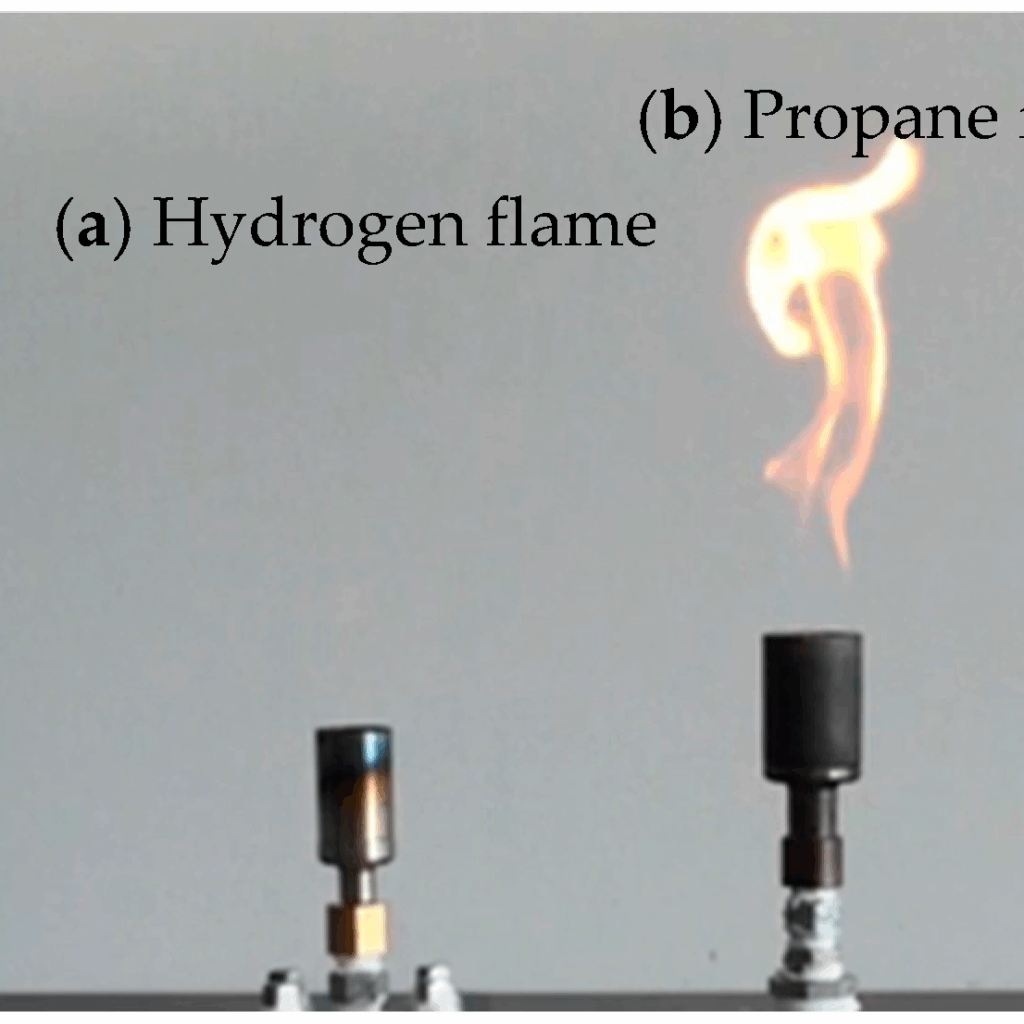
A hydrogen leak which catches fire will produce a very pale blue, almost invisible flame which is easy to miss and personnel may unknowingly walk into or place a hand into a hydrogen flame.
To the right is a photograph of a hydrogen flame and a propane flame side by side under 1000 lux of 2800 K halogen lamp illumination. Yes, the hydrogen burner is lit. Source: Sensors 2018, 18(1), 314; https://doi.org/10.3390/s18010314
Because hydrogen is extremely flammable and readily explosive, extreme care must be taken so that it never comes into contact with air. Liquid hydrogen cylinders should never be used for other cryogenic liquids, and cylinders intended for other cryogenic liquids should never be used for liquid hydrogen. All lines used to transfer hydrogen gas or liquid must be thoroughly purged of air by evacuating the lines and backfilling with inert gas at least three times. Additionally, any pressure relief valves on a liquid hydrogen cylinder must be routed to minimize the risk of creating a flammable or explosive mixture with air. Transfer lines carrying liquid hydrogen are also prone to condensing air and forming oxygen enriched liquid or atmosphere, which only increases the risk of fire or explosion when working with liquid hydrogen. Vacuum insulated transfer lines are thus a necessity with liquid hydrogen.
Unlike nitrogen and argon, which are denser gases than air, hydrogen as a gas is far less dense than air. With liquid nitrogen and liquid argon, the largest concentrations of vented or boil-off gas will be close to the ground, especially in recessed areas. However, with liquid hydrogen the vented gas will accumulate at ceiling level, at the highest point. Hydrogen concentrations can be far greater in vaulted areas of the ceiling or in the open area above a drop ceiling, where room ventilation systems may not flush it out as effectively, and where wiring and lighting may provide ignition sources. These types of features pose a large asphyxiation and fire/explosion hazard.
The inherent dangers of working with liquid hydrogen cannot be overstated, and both OSHA and Cal/OSHA have very strict regulations governing the design and construction of liquid hydrogen installations. A thorough review by EHS personnel and the Fire Marshal will be needed for any proposed work with cryogenic liquid hydrogen.
For an example of how easily hydrogen can ignite, see this Lessons Learned on a recent hydrogen explosion at UH Manoa, in which a hydrogen explosion was triggered by common static electricity.

