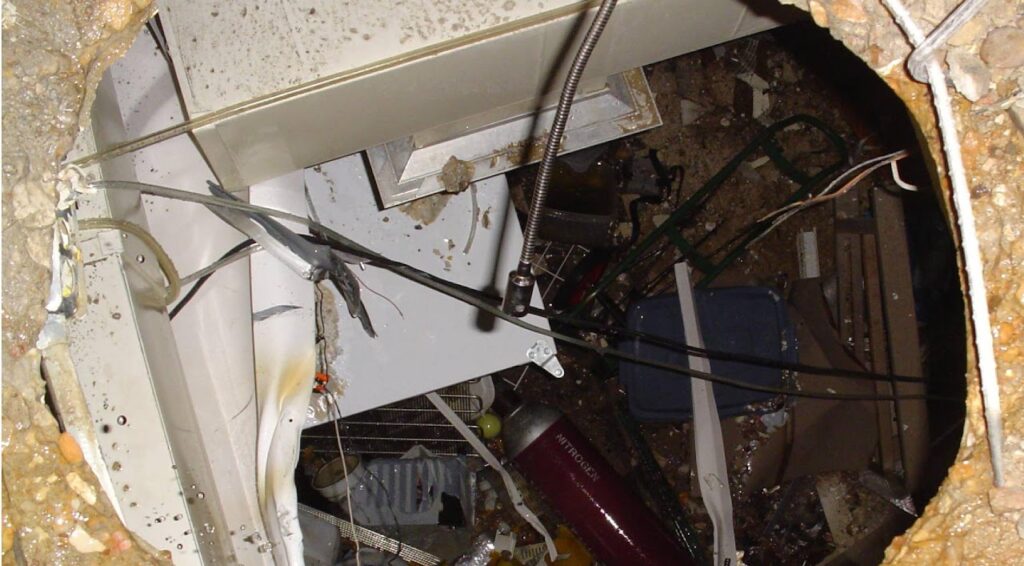
Cryogenic liquids are stored at temperatures far below ambient temperature, but just barely below their own boiling point. This means that upon exposure to heat from ambient air or materials, cryogenic liquids boil rapidly and convert completely to gas. If confined to a rigid volume and allowed to warm to room temperature, cryogenic liquids can exert pressure in excess of 10,000 pounds per square inch (psi). Given that even high-pressure vessels are typically built to withstand pressures near 1,000 psi, this is enough pressure to rupture just about any system, and will certainly rupture a cryogenic liquid cylinder if it does not have adequate pressure relief. Because of this, it is extremely important to ensure that every single isolatable part of a cryogenic liquid system has adequate pressure relief to ensure that pressure from trapped cryogenic liquid can never build up between valves or in any container. It is incredibly dangerous to modify commercially available cryogenic liquid containers, especially if doing so requires adding additional parts or removing pressure relief. Cryogenic liquids should never be stored in a container that is not specifically designed and engineered to safely hold cryogenic liquids.
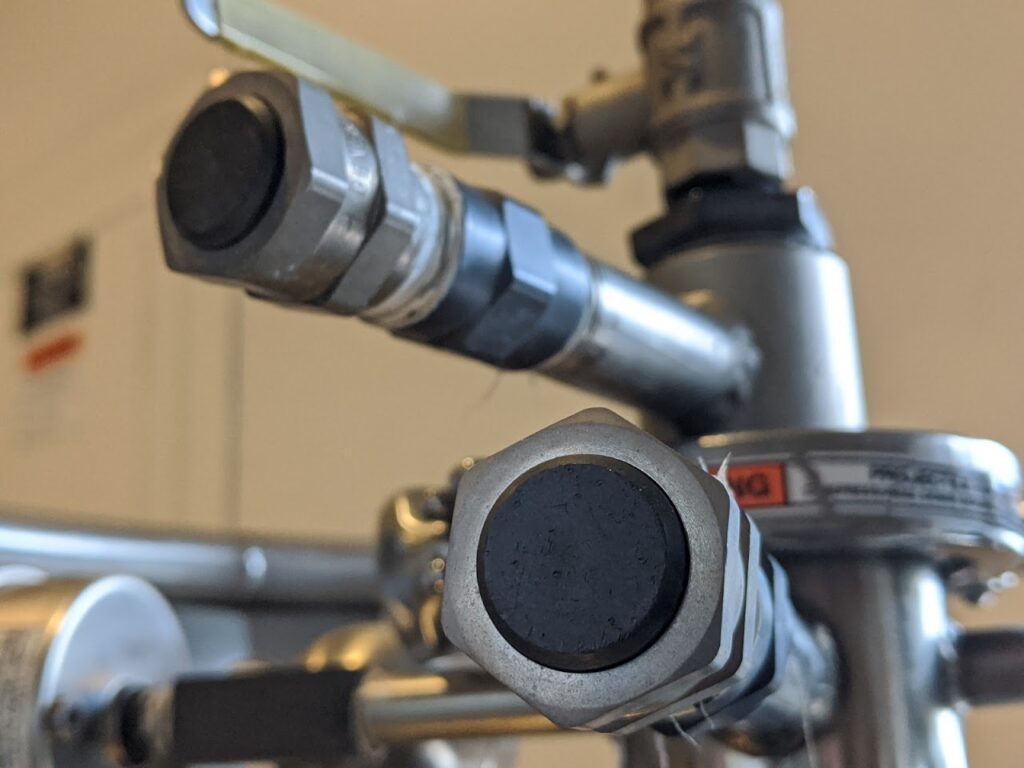
Redundant Pressure Relief

Vacuum Space Pressure Relief

So what happens when a trapped cryogenic liquid explodes its container?
The result is referred to as a boiling liquid expansion vapor explosion, or BLEVE, and it’s not unique to cryogenic liquids. The Mythbusters conducted an experiment following reports of exploding water heaters in which they intentionally created the conditions for such an explosion by removing the pressure relief on a commercial water heater and heated the water above its normal boiling point under pressure. A liquid only boils when its vapor pressure (a function of temperature) meets or exceeds the pressure at the surface of the liquid. In a closed container where pressure is allowed to build up, this means that the liquid can be heated far in excess of its normal boiling point, with the pressure continually rising as the temperature increases.
At some point during this process when the pressure becomes too great, the container will fail. When that happens, the excess pressure is released. Now the pressure on the surface of the liquid is not nearly sufficient to prevent boiling, and the liquid flash boils – expanding at supersonic speeds and creating the characteristic shockwave of an explosion. The hotter the liquid was before the container fails, the more liquid will flash boil, and the larger the explosion.
For an excellent demonstration of a BLEVE, the cryogenic liquids SME highly recommends watching the Mythbusters episode “Exploding Water Heater” which aired on November 7, 2007. The water heater explosion is a classic example of a BLEVE, accomplished with nothing but water and heat.

