Transporting Dry Ice
Dry ice may be transported throughout a building and in the elevator. Small quantities of dry ice in a lidded Styrofoam container may be transported in the elevator with passengers. Bulk quantities of dry ice (such as the large bins provided by Praxair) should not be accompanied in the elevator by LBNL employees.
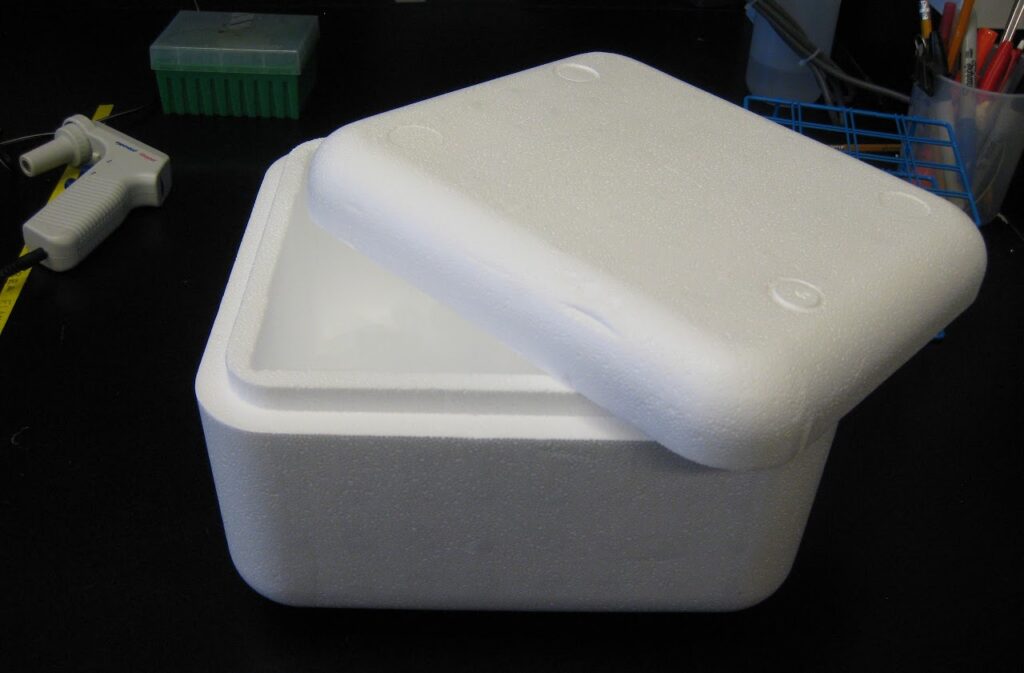
Transportation of small amounts of dry ice is best accomplished in an insulated container, such as a Styrofoam box (pictured to the top left). Research materials that must be kept frozen in transit are often shipped in these boxes, so they are usually easy to obtain. This is also the best way to store a small amount of dry ice for prolonged periods of time, as the insulation will slow the sublimation of the dry ice. NEVER attempt to transport or store dry ice in a closed container that is not meant to hold dry ice, even if it is only loosely closed. Water can condense and freeze in any gaps, sealing the container. The sublimation can pressurize a container with inadequate venting capacity, leading to explosion with significant force.
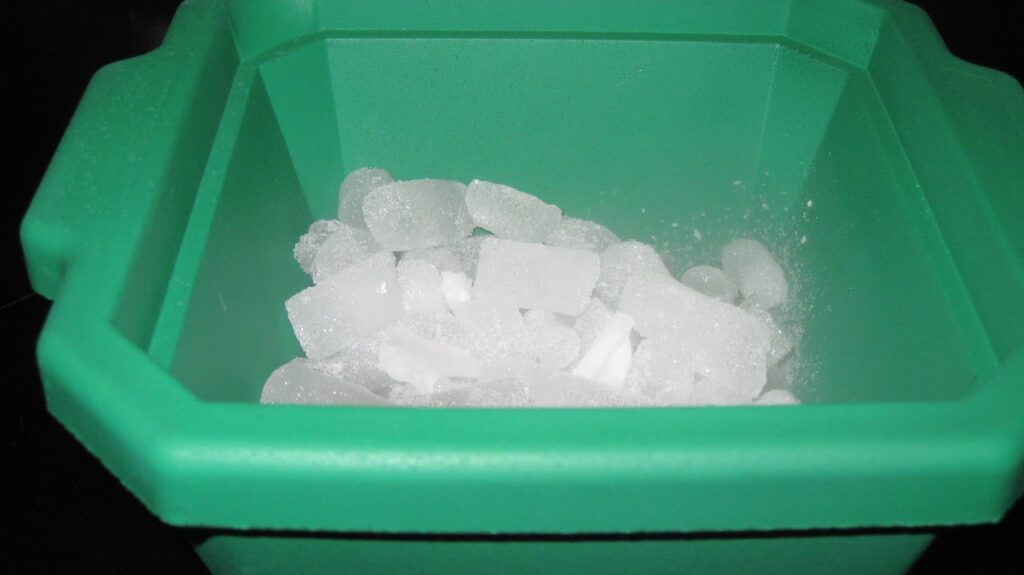
Small insulated plastic tubs, such as the one pictured on the bottom left, can also be useful for short-range transportation of dry ice.
Transporting Non-Pressurized Dewars of Cryogenic Liquids
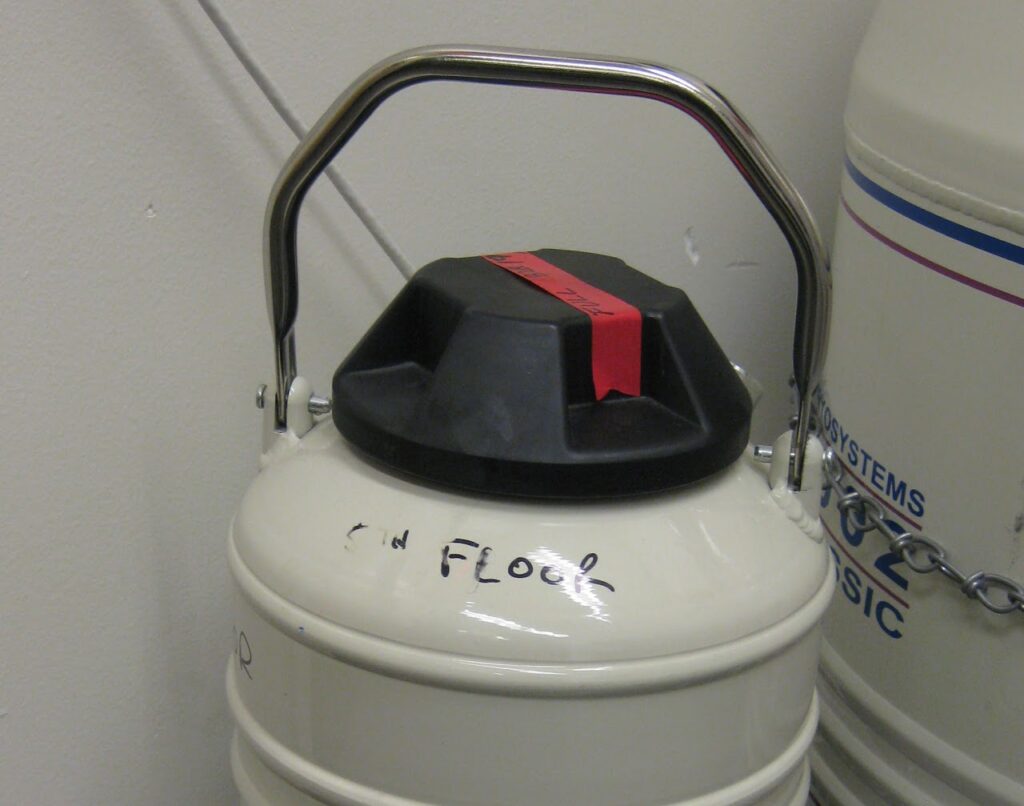
Proper transport Dewars for hand-carrying small amounts of cryogenic liquid will have a loose fitting cap and either a handle or a wheeled base. Small Dewars (5L and less) tend to have a carry handle, while larger, heavier Dewars will often come supplied with a wheeled base (which may be detachable).
These Dewars can sometimes be transported safely in an elevator, but it is important to consider the total amount of cryogenic liquid and the size of the elevator. If you are in doubt, put the Dewar in the elevator, chain off the elevator (see Transporting Pressurized Dewars below for details), take the stairs to your desired floor, and call the elevator to you.
What happens if you get trapped in an elevator with a Dewar?
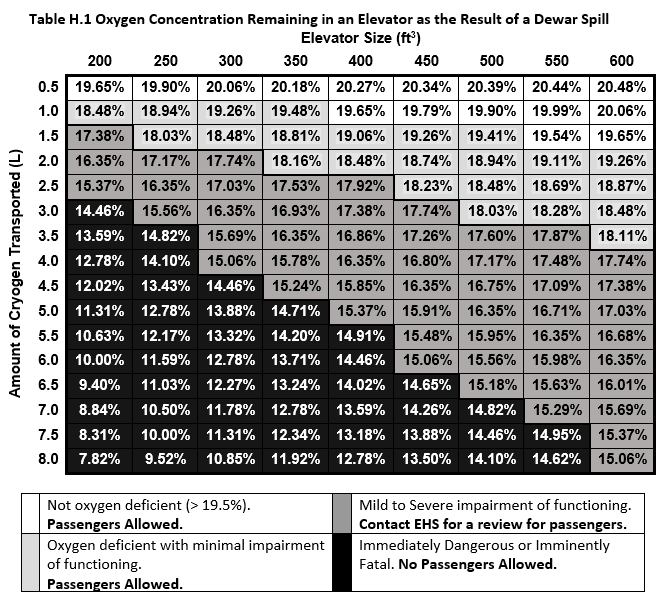
If the power goes out or the elevator fails while you’re in an elevator with a transport Dewar, the liquid nitrogen inside will slowly boil off into the elevator. If the power failure is due to an earthquake, your Dewar may also spill. The following chart gives a conservative approximation of what the oxygen concentration in an elevator would be if you were trapped indefinitely with a given sized transport Dewar. For reference, most of the elevators on site are between 300 and 500 cubic feet in volume.
You’ll notice that the safe/unsafe cutoff is right about 4L of liquid nitrogen, which is conveniently a common size for transport Dewars, and also about the largest Dewar that most people can carry comfortably.
Transporting Pressurized Dewars
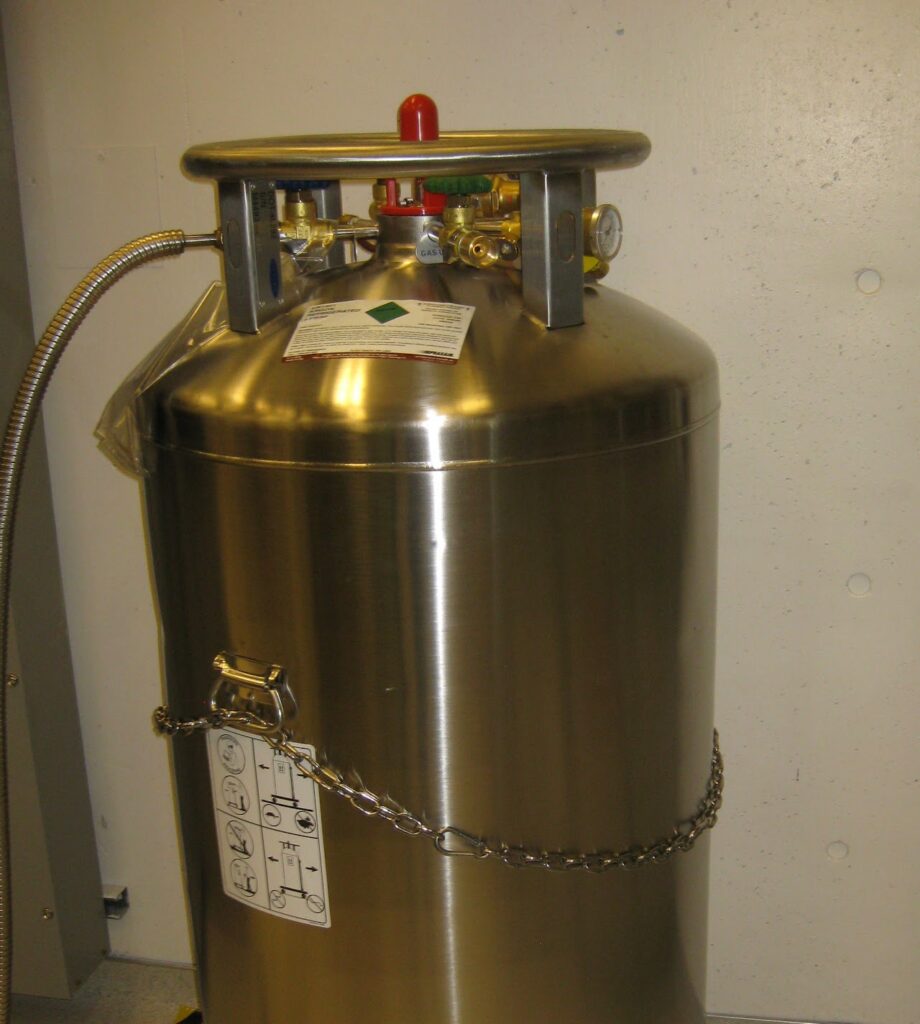
Pressurized Dewars can weigh upwards of 600 lb (270 kg). Trying to move one of these Dewars without a cart can lead to serious injury, and the carts for moving them can be specific to the Dewar type so that a cart for one Dewar might not work for another. It’s highly recommended to have two people work together to move a pressurized Dewar to ensure that the cart is attached properly and the trip goes as smoothly as possible.
Because these Dewars are pressurized, if they fail they will vent gas much faster than an unpressurized transport Dewar, and can rapidly displace the oxygen in an enclosed area. For this reason, LBNL does not allow any passengers to accompany pressurized Dewars in a elevator, regardless of size. The elevators in buildings where pressurized Dewars are transported will have a chain that can be used to block entrance to the elevator and warn others to stay out while Dewar transport is in progress. If you need to use an elevator that does not already have a chain and sign in place for transporting pressurized Dewars, please call your Building Manager or Division Safety Coordinator.
Long-Distance Moves
If you need to transport a Dewar of cryogenic liquid, or a large amount of dry ice, farther than an adjacent building, please arrange to have Facilities perform the move. See Transportation Services for more information, on the A-Z index under T for Transportation.

