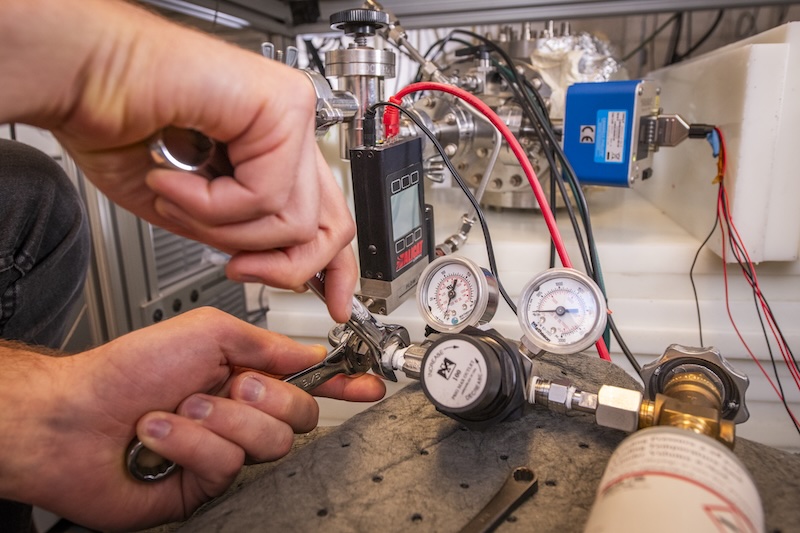
Liquid helium is the coldest of all the cryogenic liquids, with a boiling point of approximately 4 Kelvin (-268.9°C or -452.1°F). This incredibly low temperature is cold enough to solidify air (the nitrogen and oxygen, not just the water) into a kind of ice. Because of this, it is far more common to accumulate solid obstructions in the valves of pressurized liquid helium cylinders than with nitrogen or argon. Users of liquid helium cylinders must exercise extreme care to prevent obstructions, which can cause liquid helium vessels to over-pressurize rapidly. See Pressurization and Explosion Hazards for more information about the consequences of over-pressurization in cryogenic liquid applications.
At the ALS, this exact situation occurred. A liquid helium cylinder was in use at the ALS, and a user failed to close one of the valves when finished with their operation. Nothing seemed amiss until a few days later, when another user went to withdraw liquid from the cylinder. This particular cylinder required that a long metal tube, a “stinger”, be inserted through the top of the cylinder all the way to the bottom of the cryogenic liquid reservoir in order to withdraw liquid. But the user found that the tube would not insert all the way; instead, it hit something hard well above the bottom of the reservoir. It turned out that air had entered the cylinder through the valve that was left open, had frozen solid on top of the liquid helium, and formed an impenetrable plug. Had the situation not been discovered and remedied, the cylinder may have exploded as the helium trapped below the plug slowly vaporized and built up pressure in the confined space.
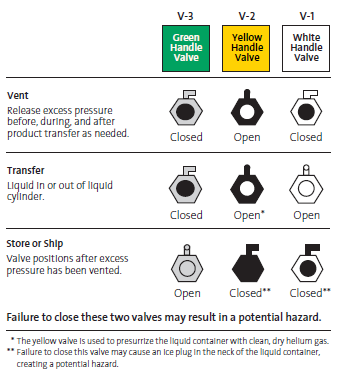
Pressurized liquid helium cylinders are rarely operated at high pressures like liquid nitrogen or liquid argon which come in cylinders with pressures up to 350psig. Instead, most liquid helium cylinders are operated at less than 20psig. Cryogenic liquid cylinders used for helium sometimes have more complex insulation systems to minimize loss rates, which can be quite high for liquid helium. Cryogenic liquid cylinders intended for use with liquid nitrogen or liquid argon are likely to be unsuitable for containing liquid helium. Many liquid helium cylinders also do not have a liquid withdrawal valve, and require the use of a “stinger” to extract liquid helium. The stinger is a long metal tube that is inserted into a port at the top of the cylinder. Inserting a stinger into a cylinder is much more dangerous than using a built-in liquid withdrawal valve. On-the-job training is absolutely required for using a stinger system, and people who are new to the procedure would greatly benefit from supervised practice before attempting it without direct help.
Always check that the cryogenic liquid cylinder is clearly marked for use with helium before attempting to fill it with liquid helium. Follow all manufacturer’s instructions for the cylinder carefully to prevent ice obstructions and over-pressurization of the cylinder. Valve sequencing may be far more complex, even for routine operations, and is incredibly important, as demonstrated by the incident at ALS.
Unlike nitrogen and argon, which are denser as gases than air, helium as a gas is far less dense than air. With liquid nitrogen and liquid argon, the largest danger of asphyxiation is close to the ground, especially in recessed areas. However, with liquid helium the largest danger of asphyxiation is at ceiling level, where the helium gas will accumulate and displace oxygen most rapidly. Therefore, when working with cryogenic liquid helium, users must be aware of what is above them. People on catwalks or ladders will be more quickly affected by a release of helium gas than someone on the ground.

